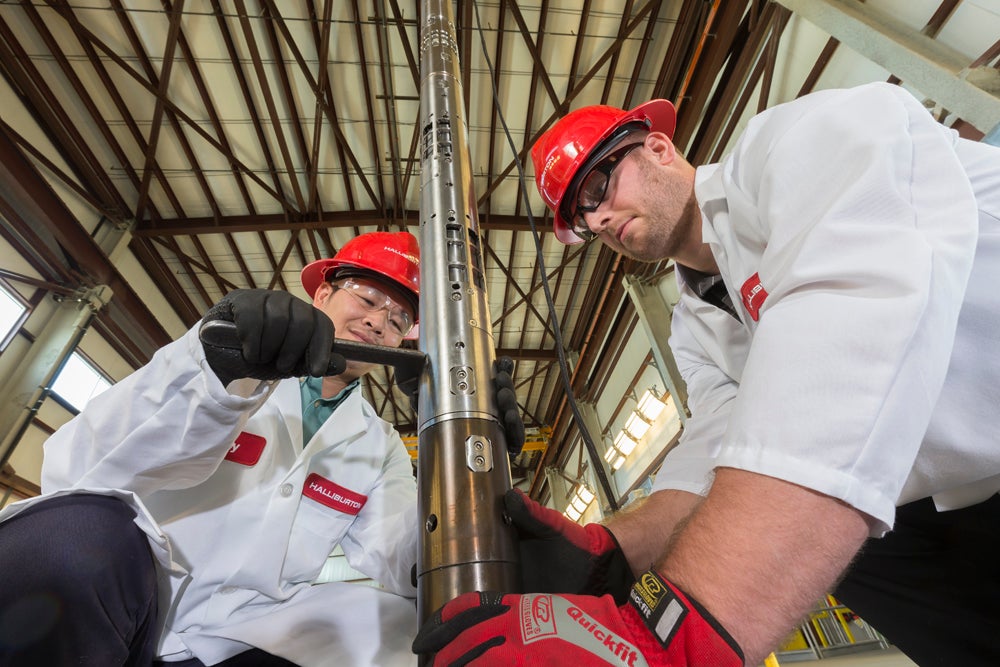
Crossed-dipole sonic tool with four monopoles delivers high-resolution elastic properties
Talk to an expertIs a step change in acoustic formation evaluation. It provides operators with high-fidelity data and advanced processing capabilities to more accurately characterize seismic properties, geomechanics, and completion needs in a wide range of reservoirs, from poorly consolidated high-porosity gas-saturated sandstones to low-porosity carbonates.
The XSI service reduces risk by measuring true formation P-wave velocity beyond the altered zone using the farthest-spaced monopole in the industry. It also measures S-wave velocity in all formation types in real time without need for additional dispersion correction processing. The unique onboard memory guarantees high-resolution data integrity and augments the real-time data streams. Additionally, in-hole tool programmability allows quick configuration changes between logging programs, ranging from conventional cement bond log mapping in cased holes to deep formation imaging in open holes.
All Halliburton Xaminer acoustic components and processing technology are combined into one state-of-the-art tool string for open and cased-hole sonic logging. The XSI crossed-dipole acoustic service takes advantage of densely spaced azimuthal receiver arrays and two low-frequency, broadband shaker sources with unprecedented modal purity to make it easy to determine fast and slow shear-wave velocities.
They provide enhanced flexibility in run designs, as well as options for cement bond logging, advanced P-wave applications, such as radial profiling, altered zone detection, and acoustic imaging, and Stoneley analysis of borehole-intersecting fractures and vertical transverse isotropy measurement for Thomsen gamma (γ).
Min Hole Size
Max Weight below Tool (lb)
PSI Max Pressure
Max Temp